Leo
Kees
Personal Statement
From the beginning of my artistic practice, I have used non-fiction and documentary material to create performances. My work explores how knowledge is produced, embodied, emotionally processed, and transformed into artistic experience.
Antropomorfia (2010), supported by Tanzplan Dresden and co-produced by HELLERAU and the Semperoper, was inspired by Darwin’s The Expression of the Emotions in Man and Animals and the work of zoologists Frans de Waal and Desmond Morris. It explored connections between emotional expression, evolution, pop music, and classical culture.
Environmental and social systems became central to TRASHedy (2011), produced by tanzhaus nrw and inspired by Daniel Goleman’s concept of ecological intelligence. The production was later analysed by Julia Dina Hesse in her doctoral dissertation on Anthropocene narratives in performance for young audiences. In Das Unsichtbare Haus (2016), commissioned by Theater Münster, I extended this research by presenting migration as a natural and continuous part of human development—and as an artistic response to growing hostility towards migrants. Both productions received the Westwind Prize for best production for young audiences in North Rhine-Westphalia. TRASHedy was also selected by AUGENBLICK MAL! as one of Germany’s most outstanding productions for young audiences, invited to the festival in Berlin, and performed worldwide over 300 times.
Further works continued this dialogue between performance and scientific research. For Pleasure (Marseille, 2012) explored sexuality, normative desire, and legality. Sex, Drugs, Ethics, History and Rock’n’Roll (Frankfurt, 2018) questioned Hesse’s official educational canon and imagined what alternative school curricula might look like if teachers and politicians were suddenly replaced by artists. HIGH (Frankfurt, 2024) examined young people’s growing dependency on illicit drugs and prescription medication, drawing on interviews with doctors, toxicologists, sociologists, and criminal investigators. THE FOOD SHOW! (Cologne, 2024) explored sugar consumption, addictive patterns, dopamine loops, and behavioural conditioning.
My current long-term research project, Learning as Performance (LeAP), extends this trajectory by investigating learning as an embodied, emotional, social, and performative process shaped by attention, vulnerability, imagination, repetition, and shared physical presence.
Works (under construction)
The following list of works is a representative, narrow selection and does not follow chronological order. A complete chronological list of works can be found at the bottom of this page.
Darwin on the Spot
What can evolutionary theory reveal about contemporary human behaviour?
Developed from an ongoing interest in Charles Darwin’s writings on emotional expression, "Darwin on the Spot" explored the relationship between biological inheritance, social behaviour, and cultural identity. Combining choreography, observation, and performative experimentation, the work examined how gestures, reactions, and emotional states emerge at the intersection of instinct and learned behaviour. Rather than illustrating scientific theories, the performance used evolutionary thought as a lens through which to reconsider everyday human interactions and the often invisible patterns that shape them. Humour, physicality, and visual composition created unexpected connections between contemporary life and its evolutionary origins. Together with Anthropomorphia, the work formed part of a broader artistic investigation into how knowledge from outside the arts can be transformed into embodied and artistic experiences.


CREDITS
Performed by: Rose Lohmann, Michael Wischnowski, David Vormweg, Lorenz Nolting, Nils Kretschmer, Carl Bruchhäuser, Paulina Alpen, Thomas Kaschel, Mats Süthoff, Saskia Rudat, Ivo Schneider | Direction: Leo Kees | Choreographic assistant: Maria Elena Kaiser | Music: La Bomba del Tiempo | Video recording: Pipo Tafel | produced by the Acting Department and the Physical Theatre Department of the Folkwang University of the Arts, Essen, Germany
* for further infomration see Archive
HOLY WOOD
Who gets to be seen, and who remains invisible?
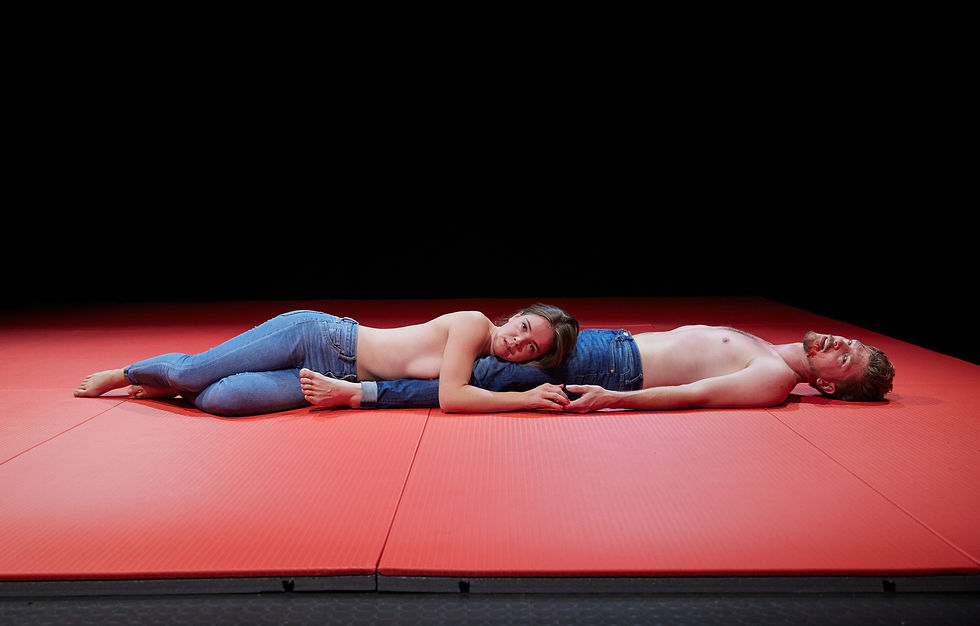
Created for two performers, Holy Wood explored how film, popular culture, and media imagery influence ideas of beauty, success, gender, and social belonging. Moving between everyday situations and iconic cinematic references, the performance examined the standards embedded in mainstream entertainment. Humour, physical transformation, and visual contrast became tools for exposing the distance between lived experience and idealised representation. Rather than criticising popular culture from the outside, the work embraced its contradictions, pleasures, and absurdities, allowing audiences to recognise themselves within the images being questioned. Positioned between dance, theatre, and visual composition, Holy Wood investigated how collective fantasies shape individual identities and how representation influences the ways people imagine themselves and others.


CREDITS
Performed by: Alejandra Jenni, Wayne Götz | Direction: Leo Kees | Choreography: Leo Kees in collaboration with Alejandra Jenni and Wayne Götz | Dramaturgical collaborator: Max Böhner | Music: Hans Zimmer, Nina Simone, Fiona Apple | produced by Leo Kees with support from Fonds Darstellende Künste, NRW Landesbüro Darstellende Künste, Ministerium für Kultur und Wissenschaft des Landes NRW and Kunststiftung NRW.
* for further infomration see Archive
Inauguration Performance of the new LWL-Museum für Kunst
How does the body shape our relationship to art, history, and cultural memory?
Commissioned for the opening of the new LWL-Museum for Art and Culture the performance began the moment visitors entered the main hall and encountered a group of nude models surrounded by artists drawing and painting them, accompanied by a large-scale video projection of the act of observation itself. Taking the human body as one of the earliest and most enduring subjects in the history of art, the work explored how meaning is produced through observation, representation, and interpretation. As audiences moved through the museum, a series of choreographed interventions activated relationships between artworks, architecture, performers, and visitors. Positioned between performance, visual arts, and public participation, the project highlighted the unique capacity of live performance to create new encounters with visual art and to foreground the active role of audiences in shaping meaning.


CREDITS
Performed by: Cornelia Kupferschmid, Jan Sturmius Becker, Juan Branca | Idea & Direction: Leo Kees. Chorephgraphy Leo Kees in Collaboration with the Team | Dramaturgy: Heike Kortenkamp | Composition & Sound design: Ralf Haarmann | Lighting design: Johannes Sundrup | Theater, cultural and art education: Johanna Kösters-Eenkhoorn, Heike Kortenkamp, Verena Kuhlmann | Assistant director: Janine Ahmann | Photo and video documentation: Johann Edelmann | Management: Rut Profe-Bracht, Judith Heese | produced by Performancekollektiv Fetter Fisch under the artistic Direction by Cornelia Kupferschmid, in cooperation with LWL-Museum für Kunst und Kultur Münster and the programme Kulturagenten für kreative Schulen in Münster.
* for further infomration see Archive
Antropomorfia
What can Charles Darwin, Frans de Waal, and Desmond Morris reveal about the ways performers express emotions on stage?
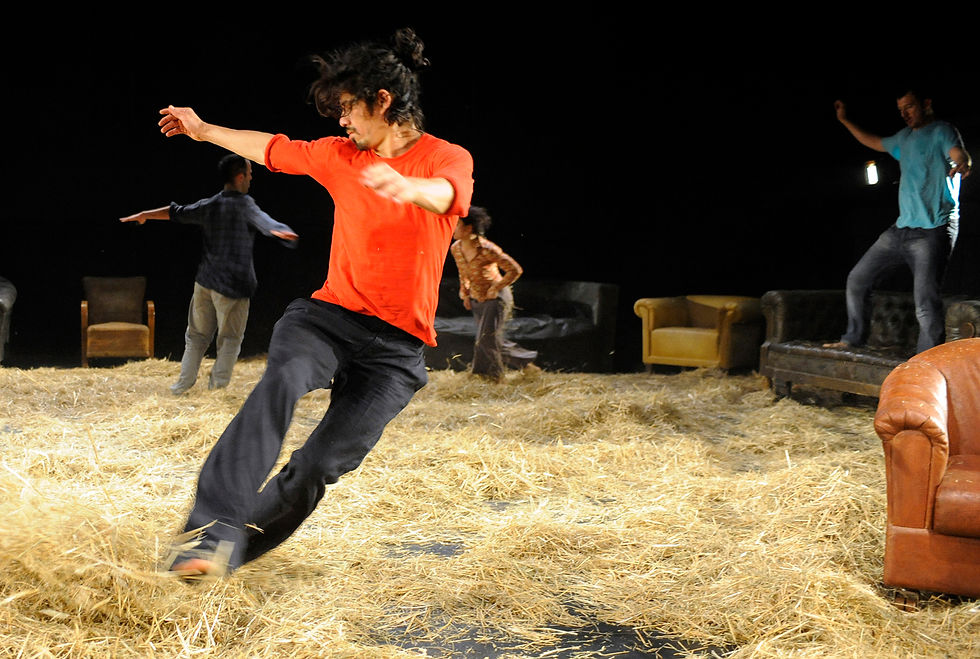
Inspired by Darwin’s The Expression of the Emotions in Man and Animals and influenced by the writings of zoologists Frans de Waal and Desmond Morris, Antropomorfia explored emotional expression through movement research, music, and visual imagery. Moving between anthropological observation and artistic imagination, the performance asked when a gesture becomes believable, what biology might have to do with authenticity, and which behaviours commonly perceived as uniquely human are shared by other mammals. Rather than proposing clear conclusions, it created a space in which audiences could reflect on the fragile boundaries between instinct and culture, nature and performance. Pop-cultural references met physical transformation, humour coexisted with observation, and emotional states became choreographic material. The production marked a significant step in a long-term investigation into how behaviour is embodied, learned, and socially performed.


CREDITS
Performed by: Juan Manuel Branca, João Fernando Cabral, Leo Kees, Julia Mota Carvalho, Marcela Ruiz Quintero | Concept & Direction: Leo Kees | Artistic Reseach: entire Team. Dramaturgy: Carmen Mehnert | Music: Johannes Schmidt | produced by Das Semperoper Ballett, Palucca Hochschule für Tanz Dresden and HELLERAU / Sabine Stenzel Tanzplan Deutschland.
* for further infomration see Archive
Apocalypse Resistance Training
What motivates people to remain politically engaged?
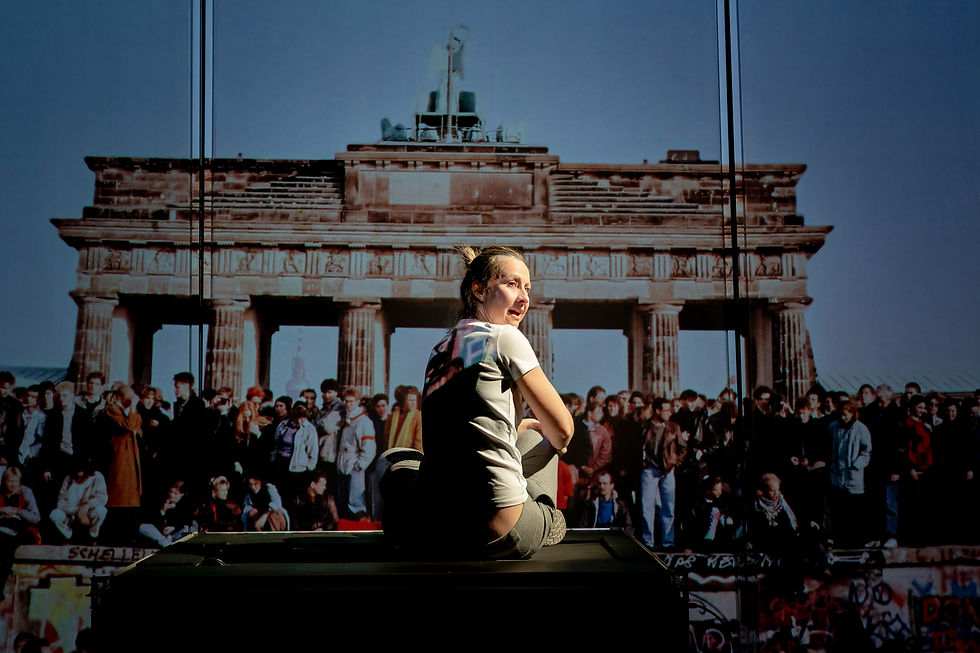
Developed with three performers whose biographies were shaped by different forms of civic and political engagement, Apocalypse Resistance Training explored how resistance is learned, practiced, and transmitted across generations. Developed for young audiences and drawing on archival material and personal experiences ranging from anti-war demonstrations and environmental activism to life in the former GDR, the performance examined the relationship between individual conviction and collective action. Rather than focusing on political events, it investigated the everyday decisions through which social commitment takes shape and endures over time. Through storytelling, movement, documentary photography, and humour, the work created a dialogue between biographies and larger historical processes.


CREDITS
Performed by: Willy Combecher, Detlef Köhler, Verena Specht-Ronique | Direction: Leo Kees | Dramaturgy: Ossian Hain and Julia Dina Heße | Video editing: Merlin Heidenreich | produced by Theater Grüne Soße. Performed among others at the Festival 'Politik im Freien Theater' at Schauspiel Frankfurt.
* for further infomration see Archive
Adaption
How can choreography temporarily release bodies from normative social behaviour?
Developed for the reopening of the Albertinum Museum – Staatliche Kunstsammlungen Dresden, Adaption extended the research initiated in Antropomorfia by exploring the relationship between human and animal behaviour. The performance placed dancers in direct dialogue with abstract, figurative, and anthropomorphic sculptures, creating a continuous oscillation between bodies perceived as social individuals and bodies perceived as physical matter. Through subtle shifts in speed, focus, weight, and intention, the choreography investigated how highly intimate forms of physical contact could gradually become naturalised and detached from the associations that often accompany human proximity in contemporary culture. At a time when bodily closeness is predominantly represented through sexuality, violence, or family relationships, Adaption proposed alternative forms of tenderness and physical organisation. Bodies merged into collective structures, temporary landscapes, and sculptural compositions, becoming partially abstracted and momentarily released from categories such as gender, culture or identity.


CREDITS
Performed by: Juan Manuel Branca, João Fernando Cabral, Leo Kees, Julia Mota Carvalho, Marcela Ruiz Quintero | Concept & Direction: Leo Kees | Dramaturgy: Carmen Mehnert | Music: Johannes Schmidt | produced by Das Semperoper Ballett, Palucca Hochschule für Tanz Dresden and HELLERAU / Sabine Stenzel Tanzplan Deutschland
* for further infomration see Archive
1984:reimagined
What happens when people refuse to play a role?
Half fiction, half reality, ‘1984: reimagined’ emerged from a series of playful refusals. Invited by Theater Paderborn to stage Orwell’s dystopian novel, I first refused to reproduce the story as intended—with its characters tortured, defeated, and ultimately crushed by oppression. The second (staged) refusal came from the performers themselves.Halfway through the performance, the performers suddenly step out of their roles, break the fourth wall, and explain to the audience why they are no longer willing to follow Orwell’s story. Instead, they decide to rewrite it. What follows are three personal perspectives on how democracy is experienced in everyday life.Through movement, theatre, sound, and visual imagery, the production examines the tension between fiction and reality, obedience and authorship, and the roles we accept—or refuse—in political life.
The final section uses texts by Brazilian judge and writer Andréa Pachá, once again blurring the boundaries between literary fiction, lived experience, and political reality.


CREDITS
Performed by: Dyana Maria da Silva, Moritz Rauch, Antonia Tenbrock | Direction, Set Design & Costume: Leo Kees | Sound design: Till Herrlich-Petry | Dramaturgy: Heike Seidler | Assistant director: Julia Zarna | produced by Theater Paderborn.
* for further infomration see Archive
THE FOOD SHOW!
Why do we eat the way we do, and how much of that choice is really ours?
This podcast-performance Combininf lip syci, h umour, interviews, and scientific research, exploring the relationship between biology, marketing, pleasure, and consumption. Starting from the observation that many of the foods we consume daily are carefully engineered to capture and maintain our attention, the show investigated how desire is shaped by evolutionary predispositions, commercial interests, and social environments. Rather than framing food through ideas of guilt, discipline, or healthy living, the work examined the mechanisms through which habits are formed and reinforced. Moving between lecture, theatrical experiment, and private reflection, audiences were invited to reconsider everyday choices that often appear personal but are deeply influenced by larger systems. The result was a playful yet critical exploration of how consumption becomes embodied behaviour.


CREDITS
Performed by: Wayne Götz, Leo Kees | Idea and Direction: Leo Kees | Dramaturgical collaboration: Julia Dina Heße | Sound design: Emilio Retamal | Technik; David Niederprüm. Theater education: Hanna Westerboer | coproduced by COMEDIA Theater Köln
* for further infomration see Archive
TRASHedy
How to perform global warming?
TRASHedy explored consumption, environmental responsibility, and “ecological intelligence” by moving from the creation of the world and human evolution to the habits of contemporary consumer society. Two performers worked their way through animated images, dance, sound collages, and an ever-growing pile of rubbish, making the consequences of seemingly ordinary decisions physically visible. The performance examined how desires and habits are formed, how personal freedom is entangled with global systems, and why knowledge alone rarely changes behaviour. Rather than offering simple solutions or raising a moralising finger, the work used humour, contradiction, and direct questions to invite audiences to reflect on their own choices.
Designed to travel easily across languages and contexts, TRASHedy transformed a complex ecological and political subject into an accessible, playful, and unsettling theatrical experience.


CREDITS
Originally performed by: Leo Kees, Daniel Mathéus | Idea & Direction: Leo Kees | Piece Development: Leo Kees, Daniel Mathéus, Martin Rascher | Dramaturgy: Daniel Mathéus, Leo Kees | Dramaturgical Collaboration: Julia Mota Carvalho | Sound Composition & Video: Martin Rascher | Drawings: Leo Kees | Production: Alexander Thun | Coroduced by tanzhaus nrw.
* for further infomration see Archive
Das Unsichtbare Haus
What if the history of life is really the history of refusing to stay put?
Most history lessons begin with dates. Das Unsichtbare Haus began several million years earlier—with a single cell making the bold decision not to remain where it was. From there, three performers attempted the modest and barrow task of explaining how life became society: how species travel, settle, adapt, build territories and, eventually, invent borders—only to behave as if migration were a recent development. Some scenes told recognisable stories; others allowed bodies, animated drawings, music and images to think out loud. Figures appeared on screen, escaped into the theatre, dissolved and returned in unexpected forms. Animation was not decoration but a restless fourth actor, carrying the production between documentary clarity, physical storytelling and poetic association.
Its proposition was simple: migration is not an interruption of history. It is one of the ways history happens. Das Unsichtbare Haus won the Main Jury Prize at WESTWIND 2016, NRW’s festival for young audiences.


CREDITS
Performed by: Linn Sanders, Manuel Herwig, Hinnerk Schichta | Direction: Leo Kees | Dramaturgical collaboration: Julia Dina Heße | Artistic Reseach: entire Team. Video animation & Sound design: Martin Rascher | Stage, Costume & Graphic design: Kristopher Kempf | produced by Junges Theater Münster.
* for further infomration see Archive
Intervention at the Museo Nacional de Bellas Artes
How does the presence of a living body change the way we experience visual art?
Created at the Museo Nacional de Bellas Artes in Neuquén, Argentina, this dance intervention explored the relationship between choreography, observation, and museum space. Rather than presenting performance as a separate event, the work was a day long intervention among visitors and artworks, creating temporary dialogues between bodies, architecture, and exhibitions. Developed in collaboration with photographer Roberto Hernández Queijo and students of the Escuela Experimental de Danza Contemporánea de Neuquén, the project investigated how movement can redirect attention and generate new perspectives on familiar spaces. By placing the body in direct conversation with the ushers artworks, the intervention highlighted the active role of observers in producing meaning and transformed the museum into a site of encounter, multiple interpetations, and mutations perspectives.


CREDITS
Performed by: Students of the Escuela Experimental de Danza Contemporánea de Neuquén | Direction: Leo Kees | Photography collaboration: Roberto Hernández Queijo | produced by Leo Kees in collaboration with the Museo Nacional de Bellas Artes Neuquén and Escuela Experimental de Danza Contemporánea de Neuquén.
* for further infomration see Archive
Chalk About
How much of what we call identity is shaped by the stories others tell about us?
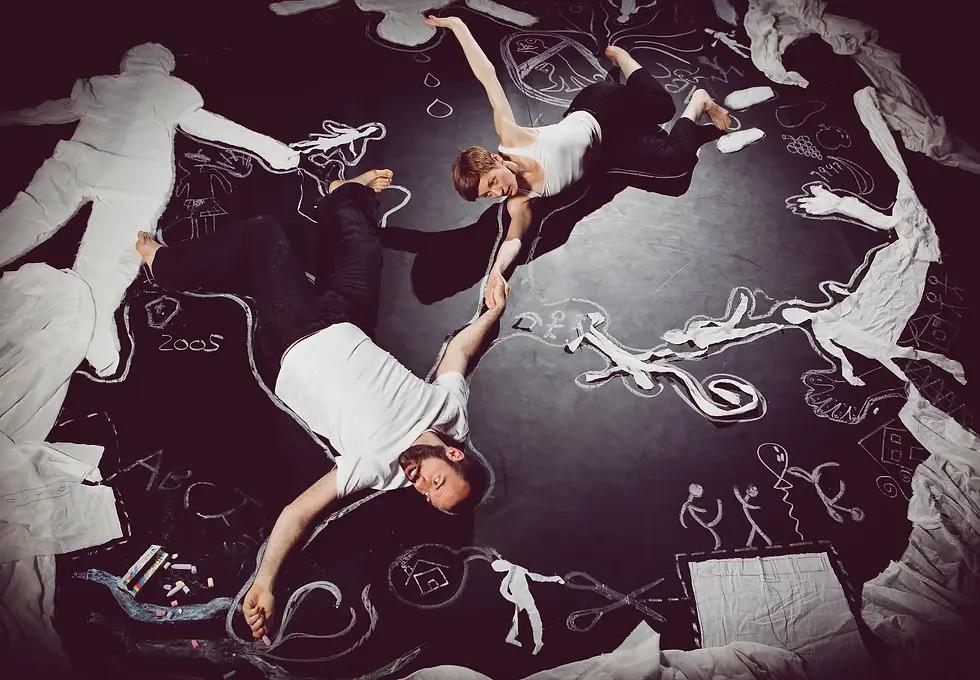
Chalk About explored cultural identity, migration, and belonging through dance, humour, and visual storytelling. Created for mixes aged audiences and Inspired by the experience of growing up between different languages, places, and cultural references, the performance examined how identities are continuously negotiated rather than fixed. Using chalk drawings, movement, and direct interaction with the audience, the work transformed the stage into a temporary map where personal histories intersected with larger social questions. Rather than presenting identity as a stable category, the show highlighted its fluid and evolving nature. Through simple visual imagery and physical storytelling, the performance invited audiences to reflect on difference, common ground, and the many ways people navigate between multiple worlds.


CREDITS
originally performed by: Christine Devaney and Leo Kees | Concept & Choreography: Leo Kees and Christine Devaney | Dramaturgy: Moos van den Broek | Music: Martin Rascher | Scenography & Costumes: Karen Tennent | Lighting design: Tom Zwitserlood | Coprodiced between Catalyst <chotland and Tanzhaus NRW, Managed in Germany by Alexander Thun, peroformed later on by performing:grpup.
* for further infomration see Archive
The Strangers
How do we decide who belongs, who remains unfamiliar, and how quickly those roles can change?
The starting point go The Strangers was investigating the mechanisms through which people construct ideas of identity, difference, and belonging. Combining movement, personal narratives, humour, and theatrical situations, the performance examined how perceptions of "us" and "them" emerge through cultural habits, social expectations, and collective imagination. Rather than focusing on strangers as outsiders, the work revealed how unfamiliarity exists within every social group and even within ourselves. Everyday encounters became starting points for reflecting on prejudice, empathy, curiosity, and fear. Positioned between documentary material and performative fiction, the production invited audiences to question the categories through which they understand others and to reconsider the fragile boundaries that separate familiarity from strangeness.


CREDITS
Performed by: Airi Suzuki (Japan), James Kan (Malaysia), Pakhamon Hemachandra (Thailand), Sang-hun Lee (Korea) | Direction & Choreography: Leo Kees | Dramaturgy: Julia Dina Heße | Stage Manager: Yoshito Takeuchi. Artistic Reseach: entire Team | Lighting Design: Masakazu Takahashi | Sound: Hisashi Tomiyama | Tour Manager: Martin Rascher | Video Documentation: Roger Walch | Project Management: Miyuki Nishimura / Goethe-Institut Osaka | produced by Goethe-Institut Osaka and ricca ricca*festa Festival, with support from ASSITEJ Korea, Taiwan Dot Go Children’s Art Festival and the Association for Artistic Creativity and Educational Development. Sponsored by Yamaoka Memorial and Goethe-Institut Osaka. The 2019 Asia Tour was supported by the Japan Foundation.
* for further infomration see Archive
Spectacular Failures
Why are some failures remembered as mistakes while others become essential moments of discovery?
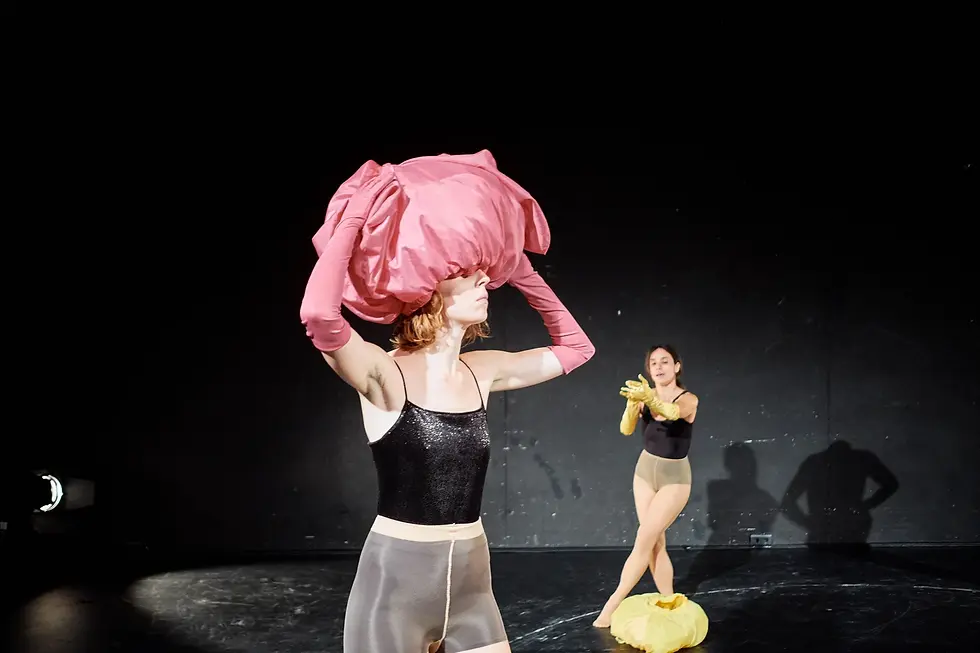
Spectacular Failures explored the cultural obsession with success by shifting attention toward error, uncertainty, and the productive potential of things going wrong. Combining dance, theatre, music, and visual humour, the performance examined failure not as the opposite of achievement but as an inevitable and often necessary part of learning, experimentation, and transformation. Performers repeatedly attempted, abandoned, reinvented, and reinterpreted actions, exposing the fragile boundary between competence and vulnerability. Rather than celebrating failure uncritically, the work investigated how social expectations shape our understanding of success and how alternative possibilities emerge when certainty disappears. Through humour and physical invention, Spectacular Failures transformed mistakes into a source of creativity, resilience, and collective reflection.


CREDITS
Performed by: Ying-Yun Chen, Constantin Hochkeppel, Marie-Lena Kaiser, Bianca Sere Pulunngam | Piece Development: Team | Direction: Leo Kees & Julia Mota Carvalho | Artistic Direction: Julia Mota Carvalho | Concept: Leo Kees | Choreography: Leo Kees, Julia Mota Carvalho, Ying-Yun Chen, Constantin Hochkeppel, Marie-Lena Kaiser, Bianca Sere Pulungan | Original Music & Sound Collages: Martin Rascher | Costume & Set Design: Andrea Barba | Lighting Design: Constantin Hochkeppel | Producer: Martin Rascher | Production Management: Martin Rascher, Laura Cadio | Assistant Director: Deborah Krönung | Technical Direction: Dietrich Schuckließ | Dramaturgical Collaboration: Daniel Mathéus | Dramaturgical Collaboration Anna Stegherr, Sibel Günbatan. produced by performing:group in co-production with tanzhaus nrw, COMEDIA Theater and Theater FELD |
* for further infomration see Archive
Slow Motion – Roller Coaster
Why is it so difficult to be still
Most history lessons begin with dates. Das Unsichtbare Haus began several million years earlier—with a single cell making the bold decision not to remain where it was. From there, three performers attempted the modest and barrow task of explaining how life became society: how species travel, settle, adapt, build territories and, eventually, invent borders—only to behave as if migration were a recent development. Some scenes told recognisable stories; others allowed bodies, animated drawings, music and images to think out loud. Figures appeared on screen, escaped into the theatre, dissolved and returned in unexpected forms. Animation was not decoration but a restless fourth actor, carrying the production between documentary clarity, physical storytelling and poetic association.
Its proposition was simple: migration is not an interruption of history. It is one of the ways history happens. Das Unsichtbare Haus won the Main Jury Prize at WESTWIND 2016, NRW’s festival for young audiences.


CREDITS
Performed by: Benjamin Cromme, Camilla Fiumara, Günther Henne, Mila Hutchinson, Michael Meyer, Uta Nawrath, Susanne Schyns | Direction & Choreography: Leo Kees | Dance Dramaturgy: Gabriel Torres Morandi | Sound Design: Jorge Espinoza | produced by Theaterhaus Frankfurt in cooperation with COMEDIA Theater Köln.
* for further infomration see Archive